
Citation Generator
Welcome to a comprehensive guide on citing sources and formatting papers in the American Psychological Association style. Below are reference and in-text citation examples, directions on formatting your paper, and background information on the style.
What is APA?
APA stands for the American Psychological Association, which is an organization that focuses on psychology. They are responsible for creating this specific citation style. They are not associated with this guide, but all of the information here provides guidance to using their style and follows the Publication Manual of the American Psychological Association.
What is APA Citing?
APA style is used by many scholars and researchers in the behavioral and social sciences, not just psychology. There are other citation formats and styles such as MLA and Chicago citation style, but this one is most popular in the fields of science.
Following the same standard format for citations allows readers to understand the types of sources used in a project and also understand their components.
The information in this guide follows the 7th edition of the Publication Manual of the American Psychological Association. It outlines proper ways to organize and structure a research paper, explains grammar guidelines, and how to properly cite sources. This webpage was created solely by BibMe to help students and researchers focus on how to create APA citations.
The 7th edition of the Publication Manual was released in 2020. We address differences between the 6th and 7th editions at the end of this guide.
For more information, please consult the official Publication Manual.
We cite sources for many reasons. One reason is to give credit to the authors of the work you used to help you with your own research. When you use another person's information to help you with your project, it is important to acknowledge that individual or group. This is one way to prevent plagiarism. Another reason why we create citations is to provide a standard way for others to understand and possibly explore the sources we used. To learn more about citations, check out this page on crediting work. Also, read up on how to be careful of plagiarism.
What Does it Look Like?
There are two types of citations:
- In-text/Parenthetical citations: Those that are found in the body of a project are called in-text/parenthetical citations. They're added into a project when a direct quote or paraphrase has been added into your work. These citations only include the name(s) of the author(s), date, and page number(s), if applicable.
- References: Those that are found on the final part of a project are called references. They're are found in the reference list (sometimes called APA works cited by some teachers), which is at the end of the assignment. It includes the full information of all sources used in a project. These types of references show the author's name, date published, title, publisher, URL, and other key pieces of information.
Depending on the types of sources used for your project, the structure for each citation may look different. There is a certain format or structure for books, a different one for journal articles, a different one for websites, and so on. Scroll down to find the appropriate APA format structure for your sources.
Even though the structure varies across different sources, see below for a full explanation of in-text citations and reference citations.
Still wondering, "What is APA format?" To learn more about APA referencing, including access to the American Psychological Association's blog, formatting questions, & referencing explanations, click on this link for further reading on the style. To learn more about using the BibMe service (BibMe.com) to help build APA citation website references, see the section below titled, "Using the BibMe Online Writing Center to Create Citations for your Reference List or APA Bibliography."
Citing Basics
In-Text Citations Overview
When using a direct quote or paraphrasing information from a source, include an in-text or parenthetical citation into the body of your project, immediately following it.
An APA in-text citation may look similar to this:
Author's Last name (Year) states that "direct quote" or paraphrase (page number).
Parenthetical citations look like this:
"Direct quote" or paraphrase (Author's Last name, Year, Page number).
These types of APA citations always have the author and the date together.
Only direct quotes need a page number. For paraphrased information, it isn't necessary, but helpful for the reader.
See the section below titled, "In-Text or Parenthetical Citations," for a full explanation and instructions.
Full References Overview
Each source used in your project is listed as a full citation on the APA reference page, which is usually the last part of a project.
The structure for each citation is based on the type of source used. Scroll down to see APA format examples of some common source formats.
Most print and offline citations include the following pieces of information, commonly in this order:
Most online citations include the following pieces of information, commonly in this order:
To see how to format each section, scroll down to the appropriate areas of this guide. There is a section on authors, one on publication dates, another on titles, publishers, and on online information.
To determine the exact APA citation format for your full citations, scroll down to the section titled, "Common Examples."
For a detailed explanation on formatting your reference list, scroll down to the section titled, "Your Reference List."
Here's a quick snapshot of the basics:
All in-text citations included throughout the paper should have a corresponding full reference at the end of the project.
Full references go on their own page at the end of a project. Title the page "References"
References are listed in alphabetical order by the first word in the reference (usually the author's last name, sometimes the title).
- If the reference begins with the words A, An, or The, ignore them and alphabetize the reference by the word following it.
If you're looking for an easy way to create your references and citations, use BibMe's free APA citation machine, which automatically formats your sources quickly and easily.
Citation Components
How to Structure Authors
Authors are displayed in reverse order: Last name, First initial. Middle initial. End this information with a period.
APA format example:
In an APA citation, include all authors shown on a source. If using the BibMe APA citation builder, click "Add another contributor" to add additional author names. Our free citation creator will format the authors in the order in which you add them.
Multiple authors, same last name:
If your reference list has multiple authors with the same last name and initials, include their first name in brackets.
Example:
No author:
When no author is listed, exclude the author information and start the citation with the title followed by the year in parentheses.
Editors:
When citing an entire edited book in APA format, place the names of editors in the author position and follow it with Ed. or Eds. in parentheses. See below for examples of citing edited books in their entirety and also APA citation format for chapters in edited books.
Comparison chart:
Use this handy chart to determine how to format author names in citations and references.

How to Structure Publication Dates
General structure is:
- Year, Month Day
- Example: 1998, March 22
Place the date that the source was published in parentheses after the name of the author. In APA format for periodicals, include the month and day as well. If no date is available, place n.d. in parentheses, which stands for no date. For more details, see Section 9.14 of the Publication Manual.
How to Structure the Title
For book titles: Only capitalize the first letter of the first word in the title and the same for the subtitle. Capitalize the first letter for any proper nouns as well. Place this information in italics. End it with a period.
Example:
For articles and chapter titles: Only capitalize the first letter of the first word in the title and the same for the subtitle. Capitalize the first letter for any proper nouns as well. Do not italicize the title or place it in quotation marks. End it with a period.
Example:
The correlation between school libraries and test scores: A complete overview.
For web pages on websites: Same as above. The web page title is italicized.
Example:
For magazine, journal, and newspaper titles: Each important word should start with a capital letter.
Example:
The Boston Globe
If you believe that it will help the reader to understand the type of source, such as a brochure, lecture notes, or an audio podcast, place a description in brackets directly after the title. Only capitalize the first letter.
Example:
How to Structure Publication Information
Publisher Location
In previous editions of the publication manual, books and sources that were not periodicals indicated the city and state of publication. However, in the 7th edition, the location of publication is no longer given except “for works associated with specific locations, such as conference presentations” (p. 297).
For conference presentations, give the city, state/province/territory, and country. If in the US, abbreviate the state name using the two-letter abbreviation. Place a colon after the location.
Examples:
- Philadelphia, PA:
- Rotterdam, Netherlands:
Periodical Volume and Number
For journals, magazines, newspapers, and other periodicals, place the volume number after the title. Italicize this information. Place the issue number in parentheses and do not italicize it. Afterwards, include page numbers.
Example:
If you're citing a newspaper article, include p. or pp. before the page numbers.
How to Structure the Publisher
The names of publishers are not necessary to include for newspapers, magazines, journals, and other periodicals.
For books and other sources: It is not necessary to type out the name of the publisher exactly as it is shown on the source. Use a brief, but understandable form of the publisher's name. Exclude the terms publishers, company, and incorporated. Include Books and Press if it is part of the publisher's name. End this information with a period (See Section 9.29 in the Publication manual for more details).
Example:
Little Brown and Company would be placed in the APA citation as: Little Brown.
Oxford University Press would be placed in the citation as: Oxford University Press.
How to Structure Online Sources
For sources found online:
- include the URL at the end of the citation
- do not place a period after the URL
If you're citing a periodical article found online, there might be a DOI number attached to it. This stands for Direct Object Identifier. A DOI, or digital object identifier, is a unique string of numbers and letters assigned by a registration agency. The DOI is used to identify and provide a permanent link to its location on the Internet. The DOI is assigned when an article is published and made electronically. If your article does indeed have a DOI number, use this instead of the URL as the DOI number is static and never changes. If the source you're citing has a DOI number, after the publication information add a period and then http://dx.doi.org/10.xxxx/xxxxxx. The x's indicate where you should put the DOI number. Do not place a period after the DOI number. See sections 9.35-36 in the Publication manual for more details.
If you're using the automatic BibMe APA reference generator, you will see an area to type in the DOI number.
Example:
Citations and Examples
Citations for Print Books
Example:
Looking for an APA formatter? Don't forget that the BibMe APA citation generator creates citations quickly and easily.
Notes: When creating an APA book citation, keep these in mind:
- Capitalize the first letter of the first word of the title and any subtitles, as well as the first letter of any proper nouns.
- The full title of the book, including any subtitles, should be stated and italicized.
Citations for Edited Books
Most edited books state on the cover or title page that they are edited by an author or multiple authors. The format is the same as a print book, except the editor's name is in the author's position. Include a parentheses afterwards with the abbreviation (Ed.) for an edited book by one author or (Eds.) for an edited book with two or more authors.
Example:
Citations for Chapters in Edited Books
Some edited books contain chapters written by various authors. Use the format below to cite an author's individual chapter in an edited book.
Notice that for APA style, the title of the chapter is not italicized, while the title of the book is. In addition, the chapter author's name is reversed at the beginning of the reference, but the editor's name is written in standard order.
Example:
In the above example, Longacre and Ayers are the authors of the individual chapter and Binford & Binford are the editors of the entire book.
Citing an E-book from an E-reader
E-book is short for "electronic book." It is a digital version of a book that can be read on a computer, e-reader (Kindle, Nook, etc.), or other electronic devices. Include the DOI or URL if one exists for the e-book.
https://doi.org/10.xxxx/xxxxxx is used when a source has a DOI number. If the e-book you're citing has a DOI number, use it in the APA citation. DOIs are preferred over URLs.
How to cite in APA (an e-book example):
Citing an E-book Found in a Database and Online
Use this format when citing an e-book that is either found on a website, or found on a subscription database. APA formatting for this is very similar to the structure of a print book. The only difference? Instead of the publisher information, include the DOI number or URL.
When citing an online book or e-book, keep in mind:
- A DOI (digital object identifier) is an assigned number that helps link content to its location on the Internet. It is therefore important, if one is provided, to use it when creating a citation. In place of the x's in the DOI format, place the 10 digit DOI number.
- Notice that for e-books, publication information is excluded from the citation.
Example:
Citations for Chapters in E-books
Need to cite a chapter in an e-book? No problem! Citing a chapter in an e-book is very similar to citing a chapter in a print book. Instead of including the publisher information, include a DOI number (if one is displayed) or the URL.
Citations for Websites
How to cite a web page on a website in APA:
APA website citation example:
Citing a web page with a group author:
Examples:
Centers for Disease Control and Prevention. (2020, February 3). Be prepared to stay safe and healthy in winter. https://www.cdc.gov/features/winterweather/index.html
National Park Service. (n.d.). Enchanting landscapes beneath the parks. https://www.nps.gov/subjects/caves/index.htm
Note: "n.d." stands for "no date" and is used when there is no publication date.
The above follows Section 10.16 of the Publication manual.
Still wondering how to cite a website in APA? Check out BibMe.com! It's quick, simple, and free! Our APA citation machine also builds references for many other styles as well!
Citations for Journal Articles Found in Print
Today, most journal articles are found online, but you may be lucky enough to score a copy of a print version for your research project. If so, use the structure below for your reference:
Notice that the article's title is only capitalized at the beginning. If there are any proper nouns or subtitles, capitalize the first letter for those words as well. The journal article's title and the volume number are both italicized. In addition, the title of the journal is in title case form (all important words are capitalized).
Example:
Citations for Journal Articles Found Online
Databases are a popular place to find high quality journal articles. These references are formatted the same way as the print versions, except the DOI or URL is included at the end. If the article has a corresponding DOI number, use it instead of the URL. No URL? Use the homepage of the journal's website for the URL. See Section 10.1 in the Publication manual for additional examples.
Example:
Notes: When creating your online journal article citation, keep in mind:
- This citation style does NOT require you to include the date of access/retrieval date or database information for electronic sources.
- Use the URL of the journal homepage if there is no DOI assigned and the reference was retrieved online. * If the journal article has a DOI number assigned to it, include that number in the citation instead of a URL.
- Don't forget, our free BibMe APA generator is simple to use! Check out BibMe Plus while you're at it! If you have a noun, conjunction, or preposition out of place, we'll flag it and offer suggestions for quick writing fixes!
Citations for a Newspaper Article in Print
Similar to journal articles, most individuals use online newspaper articles for research projects. However, if you're able to get your hands on a print version, use this structure for your reference:
Example:
Notes: When creating your newspaper citation, keep in mind:
- Begin page numbers with p. (for a single page) or pp. (for multiple pages).
- Even if the article appears on non-consecutive pages, include all page numbers, and use a comma to separate them. Example: pp. C2, C5, C7-C9.
- Include the full date of publication, not just the year like in most references.
Citations for Newspapers found Online
Use this structure when referencing a newspaper article found on a website or database:
Example:
Notes: When citing a newspaper, keep in mind:
- If the article was found on the newspaper's website, include the URL for the newspaper's homepage. For databases, include whatever URL is provided.
- Multiple lines: If the URL runs onto a second line, only break URL before punctuation (except for http://).
- This style does NOT require you to include the date of access for electronic sources. If you discovered a newspaper article via an online database, the database's information is NOT required for the citation either. If you're using the BibMe APA formatter, we make it easy for you by only including what you need in your references!
Citations for Magazines
Citing a magazine article in print:
APA format citation:
Notes: When citing a magazine, keep in mind:
- You can find the volume number with the other publication information of the magazine.
- You can typically find page numbers at the bottom corners of a magazine article.
- If you cannot locate an issue number, simply don't include it in the citation.
Citing a magazine article found online:
Example:
Notes: When creating an online magazine citation, keep in mind:
*The volume and issue number aren't always on the same page as the article. Check out the other parts of the website before leaving it out of the citation.
Citations for Blogs
Blogs are found on websites and display continuously updated content and posts by a single author, group, or company. A blog shows news updates, ideas, information, and many other types of entries. Similar to journal entries, a blog begins with the date the information was added followed by the content.
If you’re wondering how to cite a blog entry, look no further! Citing a blog is very similar to citing a website.
Citing a blog post:
Example:
Notice that the blog title only has a capital letter at the beginning. If there are any proper nouns in the title, capitalize the first letter for those as well.
Cite a blog post in the text of the paper:
(Author’s last name, Year)
OR
Author’s last name (Year)
Citations for Research Reports
A research, or technical report, is a piece of work that provides insight into research done by an individual researcher, a group of researchers, or a company or organization.
Citing a research report in print:
Note: If the publisher is the same as the author, use the name as the the “Author” and don't list the publisher.
Example:
Citing an online research report:
Author’s Last Name, F. M. or Organization. (Year published). Title of research report (Report No.). URL
Example:
Newson, S. E. & Berthinussen, A. (2019). Improving our understanding of the distribution and status of bats within the Ryevitalise Landscape Partnership Scheme area (BTO Research Report No. 716). https://www.bto.org/sites/default/files/publications/btorr716finalwebsite.pdf
Citations for Films
Example:
Citations for Online Films & Videos:
If the name of the individual who posted the YouTube video is not available, begin the citation with the user name and do not place this information in brackets.
Note: If you're discussing a certain part of the film or video in the body of your project, include a timestamp in the in-text or parenthetical citation. (Pulp Fiction, 1994, 1:15:30). The time stamp is Hours:Minutes:Seconds.
Citations for Images
Citing an image found in a print publication (such as a book or magazine) or museum:
Including the format helps the reader understand and visualize the type of image that is being referenced. It can be [Photograph], [Painting], or another medium.
Example:
Citing an image retrieved online:
Similar to citing an image in print, when citing an image found online, place the medium, or format, in the brackets. Capitalize the first letter.
Example:
Citations for TV/Radio Broadcasts
TV/Radio Broadcasts found online:
Note: When citing a TV show or episode, keep in mind:
- IMDB is a great resource for finding the information needed for your citation (Director, Writer, Executive Producer, etc.) * This information can also be found in the opening and closing credits of the show.
Type what you find into the BibMe APA formatter. We'll do the work for you and structure your references properly!
Citations for Songs
To cite in APA a song from an album listened to online, use the following structure:
Notes:
- If the song is done by a band or group, include the band or group's name instead of an individual's name.
- Only include the "Recorded by F. M. Last name" portion if it's a different individual than the writer.
- The format can be CD, Online song, mp3, or any other simple description to allow the reader to understand the format.
If you're using the BibMe APA citation generator to build your references, choose "Music/Audio" from the source options.
Citations for Interviews
A personal interview should NOT be included in a reference list. They are not considered recoverable data (they cannot be found by a researcher). You should reference personal interviews as citations in the body of the project instead.
Example:
Citations for Encyclopedia and Dictionary Entries
Encyclopedia/Dictionary in print:
Example:
Encyclopedia/Dictionary online with author(s):
Encyclopedia/Dictionary online with group author:
Example:
If an entry looks like it goes through many updates, use “n.d.” as the publication date and show the date you retrieved it. If using an archived version, no retrieval date is needed.
How to Reference a Lecture
This style of reference would be used if you were citing a set of notes from a lecture (e.g., PowerPoint or Google slides provided by your instructor).
Citing online lecture notes or presentation slides:
Example:
Tip: If you want to cite information from your own personal notes from a lecture, this is considered personal communication. The notes may not be available online for others outside of the class to access. Refer to it only in the body of your essay or project. You can follow the style guide for personal communication available in the Interview section.
Citing Social Media
Social media is everywhere, even in research projects. Many influencers post thoughts, inspirational quotes, and intriguing stories in their profiles.
If you need to cite a post from a social media platform, use this structure:
A retrieval date (date you saw the page) is needed for profile pages since the contents are likely to change over time (e.g., Instagram profile, Facebook page etc.). The structure for that is:
Some things to keep in mind:
- If the name of the individual or group is unknown, begin the citation with the handle and remove the brackets.
- If the post only includes an image or video without any text, instead of including the first 40 words of the post provide a description of the post and place it in brackets: [video of a NASA rocket leaving the atmosphere].
- The format, in brackets, can be [Tweet], [Facebook status update], [Facebook page], [Instagram photo], [Instagram video], or for a Reddit post, use [Online forum comment].
Citing a Tweet from Twitter:
Example:
Citing a Twitter profile:
Citing a Facebook post:
Example:
Citing a Facebook page:
Example:
Citing an Instagram post:
Example:
Tables
Since this citation style is commonly used in science-related disciplines, it makes sense that many students and scholars include tables in their projects.
It's a good idea to include a table in your project when:
- There is a good amount of quantitative information
- A table would promote understanding
Do not write out the information from the table in the text of your paper. Including the same information in two spots is repetitive. Either type out the quantitative information in your paper or use a table.
If you choose to include a table, make sure to:
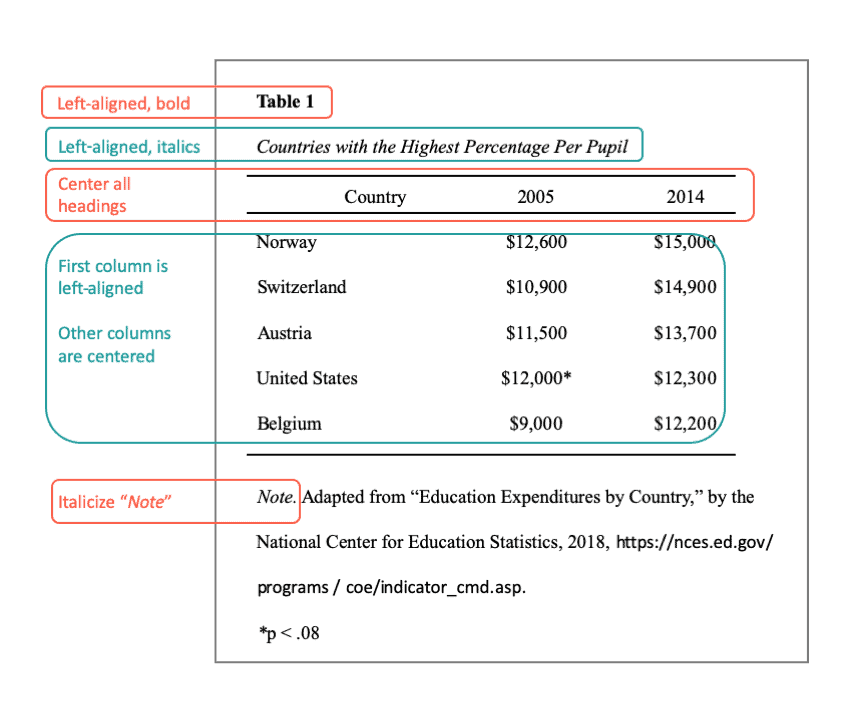
- Refer to it in the text and provide a brief overview or snapshot of its contents.
- Refer to the table in the text using numbers. For example, "Table 3 shows the countries with the highest amount of spending per pupil."
- Every table should be numbered. The table mentioned closest to the beginning of the paper should be Table 1. The next table referred to in the paper is Table 2.
- If you're submitting your project for publication in a journal or elsewhere, place all of your tables, in number order, at the end of your project, after the reference list. If you're submitting your project for a class, most professors prefer tables to be situated close to mentions in text. Ask your teacher or professor which one they prefer.
- Each table needs a title. The title of the table should match the content displayed in it. Create a name for your table that is easy to understand. Italicize the title and capitalize the first letter of all major key words.
- Do not include any vertical lines, only horizontal. Your horizontal lines should be over and above any column headings.
- Capitalize the first letter of every important word.
- Your table can either be single or double spaced. Keep the spacing in tables consistent throughout your project.
- If you believe your table needs further explanation, or if it needs additional information to help the reader with understanding, include a note below the table.
- A general note provides an overview of any information related to the table as well as an explanation of any abbreviations or unique characters. If you reproduced any portion of the table, include that information in the general note as well. Begin your general note with "Note." in italics and ending with period.
- A specific note explains information in a row, column, or individual cell. Place a tiny letter in the top right corner of the area to specify, and include information regarding it in the note below.
- A probability note displays the number of possibilities in the table. Use an asterisk symbol in the table, and show the probability in the notes.
Sample Table:
Prior to adding your table into your paper, use this handy checklist to confirm you have all of the requirements:
__ Is it necessary to include the table?
__ Are only horizontal lines included?
__ Did you include a simple, straightforward title? Is it in italics?
__ Did you use either single spaces or double spaces? APA paper format requires you to keep your tables consistent across your project.
__ Are column headings included?
__ Are notes included below the table to provide understanding? Are the notes in the proper order? Start with general notes, then include specific notes, and end with probability notes.
__ Did you refer to the table in the written portion of your paper?
Still have questions? See Chapter 7 of the Publication manual.
In-Text and Parenthetical Citations
What is an In-Text Citation or Parenthetical Citation?
The purpose of in-text and parenthetical citations is to give the reader a brief idea as to where you found your information, while they're in the middle of reading or viewing your project. You may include direct quotes in the body of your project, which are word-for-word quotes from another source. Or, you may include a piece of information that you paraphrased in your own words. These are called parenthetical citations. Both direct quotes and paraphrased information include a citation next to it. You also need to include the full citation for the source in the reference list, which is usually the last item in a project.
In-Text Citations for Direct Quotes
In-text and parenthetical citations are found immediately following any direct quotes or paraphrases. They should include the page number or section information to help the reader locate the quote themselves.
Example:
Buck needed to adjust rather quickly upon his arrival in Canada. He stated, "no lazy, sun-kissed life was this, with nothing to do but loaf and be bored. Here was neither peace, nor rest, nor a moment's safety" (London, 1903, p. 25).
Paraphrased Information
When taking an idea from another source and placing it in your own words (a paraphrase), it is not necessary to include the page number, but you can add it if the source is large and you want to direct readers right to the information.
Example:
At the time, papyrus was used to create paper, but it was only grown and available in mass quantities in Egypt. This posed a problem for the Greeks and Romans, but they managed to have it exported to their civilizations. Papyrus thus remained the material of choice for paper creation (Casson, 2001).
How to Format In-Text and Parenthetical Citations
An in-text citation in APA displays the author's name directly in the sentence, or text, of the paper. Always place the year directly after the author's name. Authors and dates stick together like peanut butter and jelly! If you're citing a direct quote, place the page number at the end of the quote.
Parenthetical citations display the author's name and year in parentheses after a quote or paraphrase. If you're citing a direct quote, include the page number as well. If you're paraphrasing, it is up to you whether or not you'd like to include a page number.
Example of various ways to cite in the body of a project:
Smith (2014) states that, "the Museum Effect is concerned with how individuals look at a work of art, but only in the context of looking at that work along with a number of other works" (p. 82).
"The Museum Effect is concerned with how individuals look at a work of art, but only in the context of looking at that work along with a number of other works" (Smith, 2014, p. 82).
If your source has two authors, always include both names in each in-text or parenthetical citation.
Example: (Franks & Beans, 2019)
If your source has three or more authors, only include the first author's name and follow it with et al.
Example: (Gilley et al., 2015)
If your source was written by a company, organization, government agency, or other type of group, include the group's name in full in the first in text or parenthetical citation. In any APA citations following it, it is acceptable to shorten the group name to something that is simple and understandable.
Example:
1st citation:
(American Eagle Outfitters /[AEO/], 2017)
2nd and subsequent citations:
(AEO, 2017)
Still wondering how to in-text cite in APA? How about citing parenthetically? Check out this page to learn more about parenthetical citations. Also, BibMe writing tools can help create your in-text and parenthetical citations quickly and easily. Towards the end of creating a full reference citation, you'll see the option to create a citation for the body of your project (in-text) in the APA format generator.
Need help with your writing? Give the BibMe Plus paper checker a whirl! Upload your paper or copy and paste it into the text box on the page. We'll run it through our innovative technology and let you know if there is an adjective, verb, or pronoun out of place, plus much, much more!
Your Reference List
The listing of all sources used in your project are found in the reference list, which is the last page or part of a project. Included in this reference list are all of the sources you quoted or paraphrased in the body of your paper. This means that every reference found in the reference list should have a matching in-text or parenthetical citation in your project. Where there is one, there has to be the other. Here are general guidelines:
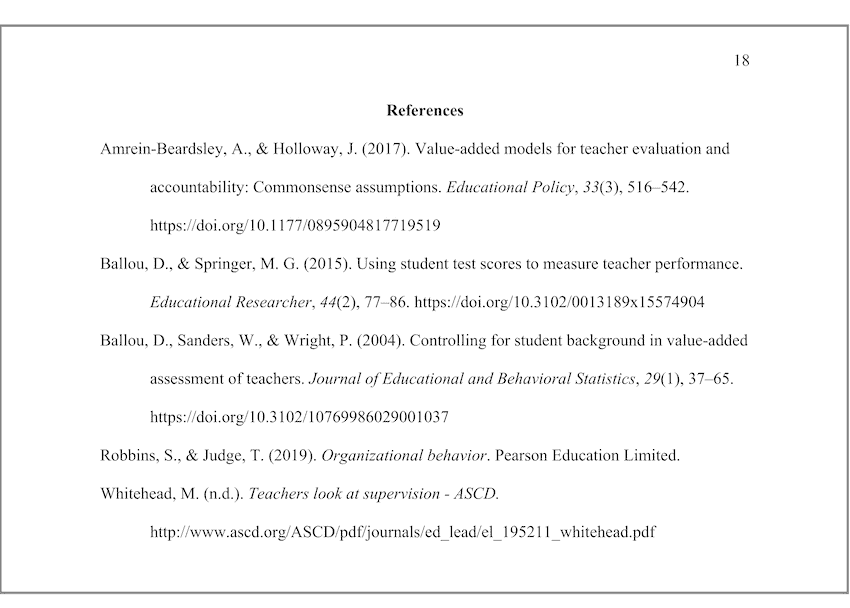
- Your reference page in APA should be titled "References"
- Place the title in the center of the page and bold it.
- It is not necessary to include personal communications in the reference list, such as personal emails or letters. These specific sources only need in-text citations, which are found in the body of your project.
- All references are listed in alphabetical order by the author's last name.
- The entire page should be double spaced.
- Use a hanging indent for all citations. The first line of each citation needs to be flush against the left margin. Any additional lines are indented in a half inch.
- If you have two sources by the same author, place them in order by the year of publication.
- Refer to the section titled, "How to Structure the Title," for rules regarding capitalization of source titles.
Example:
If there are multiple sources with the same author AND same publication date, place them in alphabetical order by the title.
Example:
If a source does not have an author, place the source in alphabetical order by the first main word of the title.
Need help creating the citations in your APA reference list? BibMe.com helps you generate citations! Begin by entering a keyword, URL, title, or other identifying information. Try it out!
Sample Reference List:
Here's more information with sample papers and tutorials. Further information acan be found in Chapter 9 of the Publication manual.
How to Format Your Paper in APA:
Need to create APA format papers? Follow these guidelines:
In an APA style paper, the font used throughout your document should be in Times New Roman, 12 point font size. The entire document should be double spaced, even between titles and APA headings. Margins should be 1 inch around the entire document and indent every new paragraph using the tab button on your keyboard. See Chapter 2 of the Publication manual for more details on paper formatting.
Place the pages in the following order:
- Title page (Page 1)
- Abstract page (page 2)
- Text or body of research paper (start on page 3)
- Reference list
- Page for tables (if necessary)
- Page for figures (if necessary)
- Appendices page (if necessary)
Page numbers: The title page counts as page 1. Number subsequent pages using Arabic numbers (1, 2, 3, 4...).
Title Page in APA
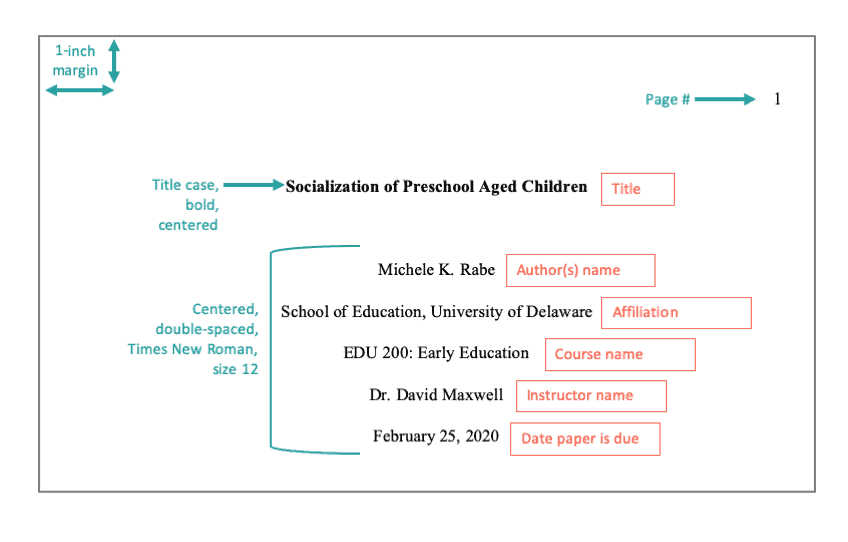
Your title page should grace the front cover of your paper. It's sometimes called an APA cover page. Included on this page are seven items:
- Page number
- Title of paper
- Name of authors
- Affiliation; name of your school or institution
- Course name
- Instructor's name
- Date paper is due
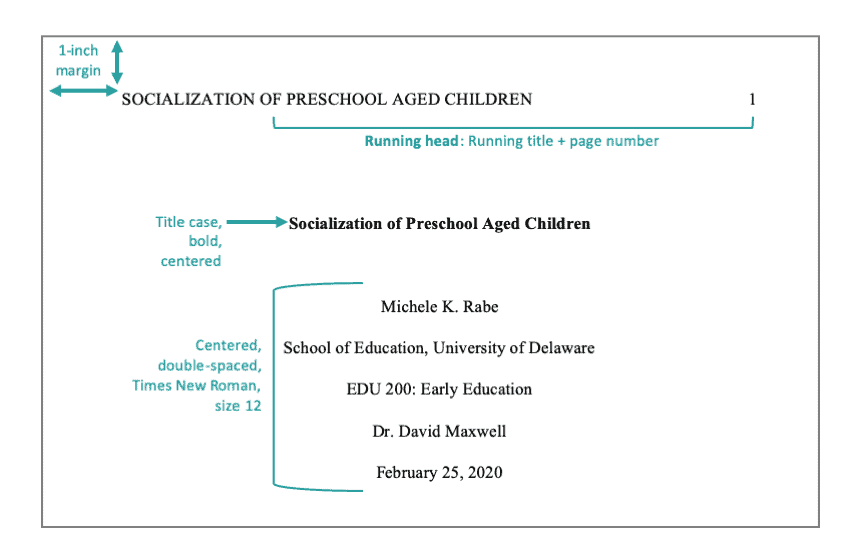
What is a running head?
The running head shows the title of your paper. It is only required for professional papers (e.g., dissertations, journal submissions, etc.).
Student papers do not need a running head (but do need the page number).
If you use one, place the running head in the top left corner of your project and place it in capital letters. Use your word processor's "header" option. It will automatically place your running head in the appropriate position, against the left margin.
Across from the running head, against the right margin, include the page number. The APA title page is 1.
Title page example:
- QUALITY LIBRARY PROGRAMS
Microsoft Word, Google Docs, and many other word processing programs allow you to set up page numbers and a repeated running head. Use these tools to make this addition easier for you!
Need help determining the title of your paper? Keep it simple and straight to the point. Exclude unnecessary terms such as "An Analysis of...." or "A Study of..." If your paper ends up being digitized and added to your school's research collection or a research database, a simple and effective title will help researchers locate it. It is recommended to keep it under 12 words and avoid abbreviations.
Order | Element | Format & Notes - | - | - 0 | All elements, except page number | Centered, double-spaced lines 1 | Page number | Place “1” in the upper right corner of the page. Professional papers only: Include a running head. 2 | Title of paper | 3-4 lines from the top of the page; bolded, and title case 3 | Name of author(s) | Two double-spaced lines under the title. No font formatting (no bold italics, underline). Exclude any titles (such as Dr. or Ms.) and degrees (such as PhD). List all contributors; if there is more than one include the word “and” between the second to last and last names. 4 | Affiliation (school, department, etc.) | No font formatting. Usually includes the name of your department and university. 5 | Course name | No font formatting. Write the course name and number on your class materials: ENG 102, JPN301. 6 | Instructor | No font formatting. Show their name as they prefer, including titles and degrees. 7 | Date paper is due | Month Day, Year. Example: February 14, 2020
Example Title Page - Student Paper:
Example Title Page - Professional Paper:
If you're looking for an APA sample paper, check out the other resources found on BibMe.com.
Levels of Headings:
There are a lot of rules to follow when it comes to styling the header and title page, but there are even more rules when it comes to styling the various headings and sections in your research paper.
There are five sizes and styles, and they follow a top down approach.
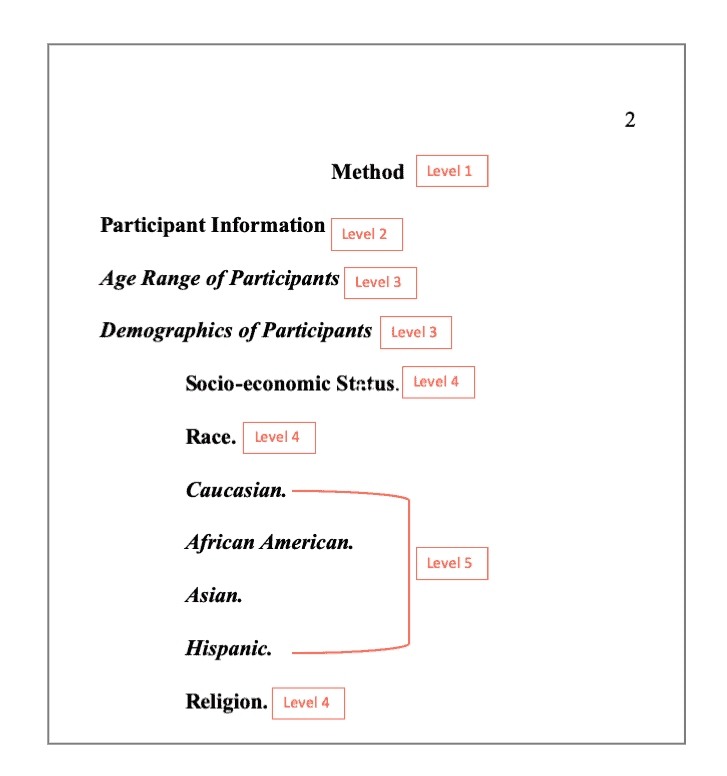
In most cases, science-related papers and case studies have three sections: Method, Results, and Discussion. These three sections are considered “Level 1” and are aligned in the center of the page and in bold. Additional sections of the paper are styled as follows:
Overview of Levels
Level | Formatting - | - 1 | Center and bold. Use title case. 2 | Against the left margin and in bold. Use title case. Begin the next sentence on the next line, indented half an inch from the left margin. 3 | Against the left margin in bold and italics. Use title case. Begin your next sentence on the next line, and indented half an inch from the left margin. 4 | Indented half an inch from the left. Is in bold. Use title case. Begin your next sentence on the same line and immediately following the heading. 5 | Indented half an inch from the left. Is in bold and italics. Use title case. Begin your next sentence on the same line and immediately following the heading.
We’ve included a visual below to help you make sense of the five headings. Keep in mind, you do not need to have all five headings in your paper. You may only use the top two or three. It depends on the types of sections your paper includes.
Using the BibMe Online Writing Center to Create Citations for your Reference List or Bibliography
Looking to cite your sources quickly and easily? BibMe can help you generate your citations; simply enter a title, ISBN, URL, or other identifying information.
Click to see more styles, and if you'd like to cite your sources in MLA format, check out the BibMe MLA page. Other citation styles are available as well.
Not only will BibMe help you create your references quickly and painlessly, we'll also scan your paper with an innovative plagiarism checker. BibMe writing tools even helps to check your grammar, too! Improper usage of adverb? Missing an interjection? Determiner out of place? BibMe writing tools will highlight any areas of concern and offer suggestions to improve your writing. Try it out now!
Background Information and History of APA:
The American Psychological Association was founded in 1892 at Clark University in Worcester, Massachusetts. APA style format was developed in 1929 by scholars from a number of different scientific fields and backgrounds. Their overall goal was to develop a standard way to document scientific writing and research.
Since its inception, the Style Manual has been updated numerous times and it is now in its 7th edition (2020). The previous 6th edition was released in 2009. In 2012, APA published an addition to their 6th edition manual, which was a guide for creating an APA style citation for any type of electronic resource.
Today, there are close to 118,000 members. There is an annual convention, numerous databases, and journal publications. Some of their more popular resources include the database, PsycINFO, and the publications, Journal of Applied Psychology and Health Psychology.
Changes Between the 6th and 7th Editions
Below is a selection of notable citing differences between the two editions.
For journal articles with a DOI number, include the DOI as a URL.
6th edition example:
7th edition example:
For ebooks, you no longer need to identify the format.
6th edition example:
7th edition example:
Full book references no longer need to show where the publisher is located.
6th edition example:
7th edition example:
In-text citations for sources with more than 3 authors can use the notation “et al.” for brevity.
Structure:
(first author’s name et al., year published)
6th edition example:
(Anaydike, Braga, Talfah, Gonzalez, 1980)
7th edition example:
(Anaydike et al., 1980)
When including a website URL, do not include the words “Retrieved from” before the URL cited.
6th edition example:
7th edition example:
The citing format for tables and figures are now the same. For both, indicate a table number and name at the top, and a note at the bottom.
Here are a few important paper formatting changes: * Running head is only required for professional (not student) papers * Only a single space should be placed after punctuation. * The new style version endorses the use of the singular “they” as an option for a gender neutral pronoun. * The 7th edition promotes the use of “they” as a singular, gender-neutral pronoun. * In addition to the paper title, author name, and institutional affiliation, a cover page for a student paper should also have the course, instructor name, and due date
References
American Psychological Association. (2020). Publication manual of the American Psychological Association (7th ed.). https://doi.org/101037/0000165-000
Updated March 10, 2020
Edited and written by Elise Barbeau and Michele Kirschenbaum. Elise is a citation expert and has her master’s degree in public history/library science. She has experience in digital marketing, libraries, and publishing. Michele is a certified library media specialist who loves citations and teaching. She’s been writing about citing sources since 2014.
Link nội dung: https://mozart.edu.vn/dinh-dang-apa-a67078.html