NHA CCMA Practice Test
Becoming a CCMA (Certified Clinical Medical Assistant) opens up many opportunities in the healthcare industry. As a Clinical Medical Assistant, you’ll play a vital role in patient care and assisting physicians and other healthcare professionals in various clinical settings. This rewarding career path requires a solid foundation of medical knowledge, excellent communication skills, and the ability to perform clinical tasks precisely.
The NHA CCMA exam is a crucial step toward obtaining your certification. It assesses your understanding of medical terminology, anatomy and physiology, clinical procedures, pharmacology, medical law and ethics, and more. This prep guide aligns with the latest exam content, ensuring you have the tools to tackle each section confidently.
The NHA exam consists of 150 scored questions. 30 additional pre-test questions are also part of the exam and are utilized to gather data about the candidate. They do not impact the candidate’s overall score. Test-takers are provided with three hours to complete the CCMA certification exam.
This prep guide offers a wealth of valuable resources. Comprehensive content reviews will reinforce your understanding of key medical concepts. Practice questions and realistic simulated exams will allow you to gauge your readiness and identify areas that require further attention. Expert tips and strategies will guide you through exam-taking, helping you manage your time effectively and confidently approach each question.
Question Types Explained
The questions included in the CCMA Januar 2024 exam fall under seven topic areas or domains. The domains divide into subcategories which account for various percentages of the overall score.
Here are the details concerning each domain:
Domain 1 - Foundational Knowledge and Basic Science
The Foundational Knowledge and Basic Science domain encompass 34 knowledge statements that cover a wide range of essential topics for clinical medical assistants. It provides a strong foundation in healthcare systems, medical terminology, basic pharmacology, and other fundamental aspects of the field. It equips aspiring healthcare professionals with the knowledge to navigate the complexities of the healthcare industry effectively.
The knowledge statements are the minimum requirement for clinical medical assistants to thrive and deliver high-quality care.
By mastering the information within this domain, individuals can establish a solid groundwork that sets them on a path to success in their healthcare careers.
Domain 2 - Anatomy and Physiology
CCMA exam domain comprises 12 knowledge statements that cover a wide range of topics, including pathophysiology, disease processes, body structures, organ systems, and microbiology.
Understanding these fundamental aspects of the human body is crucial for certified clinical medical assistants (CCMAs) as it forms the foundation of their practice. Proficiency in anatomy and physiology plays a pivotal role in ensuring success on the CCMA exam.
The domain provides CCMAs with the knowledge to comprehend the intricacies of the human body, enabling them to accurately assess patient conditions, interpret diagnostic tests, and effectively communicate with healthcare professionals.
A strong grasp of anatomy and physiology is integral to the overall competence and professional growth of CCMAs in their pursuit of optimal patient care.
Domain 3 - Clinical Patient Care
The Clinical Patient Care domain is divided into five subsections, each comprising a different number of knowledge and task statements. These subsections are:
- General Patient Care: This subsection encompasses 37 knowledge statements and 24 task statements. It covers a broad range of topics that are related to providing comprehensive care to patients, including assisting with activities of daily living, maintaining patient comfort, and ensuring patient safety.
- Infection Control: With 14 knowledge statements and 6 task statements, this subsection focuses on preventing and controlling the spread of infections within healthcare settings. It covers topics such as hand hygiene, personal protective equipment (PPE) usage, and proper handling and disposal of infectious materials.
- Testing and Laboratory Procedures: This subsection comprises 13 knowledge statements and 8 task statements. It equips CCMAs with the necessary skills to perform laboratory procedures, such as specimen collection, processing, and handling. It also covers the appropriate use of laboratory equipment and the importance of accurate documentation.
- Phlebotomy: With 22 knowledge statements and 13 task statements, this subsection delves into the specialized skill of phlebotomy. It covers venipuncture techniques, specimen handling and processing, and patient preparation for blood draw procedures.
- EKG and Cardiovascular Testing: This subsection encompasses ten knowledge and 6 task statements. It focuses on EKG (electrocardiogram) and cardiovascular testing, including the proper placement of EKG leads, basic interpretation of EKG rhythms, and assisting with stress testing.
This domain has diverse subsections. It represents the largest portion of the CCMA exam. It encompasses the day-to-day tasks that clinical medical assistants commonly perform. Mastering these skills is essential for providing effective and efficient patient care.
Domain 4 - Patient Care Coordination and Education
The Patient Care Coordination and Education domain encompasses an all-inclusive set of skills and knowledge for medical assistants interacting with patients in various healthcare scenarios.
With ten knowledge and 6 task statements, this domain ensures that medical assistants are well-equipped to provide adequate care coordination and education. The tasks in this domain range from participating in transition care for patients to engaging in team-based patient care.
Medical assistants in this role establish effective communication with patients and their families, provide education on treatment plans and medication instructions, and assist in ensuring a smooth transition between different healthcare settings. By excelling in this domain, medical assistants contribute to the quality and continuity of patient care, fostering positive patient outcomes and experiences.
Domain 5 - Administrative Assisting
The Administrative Assisting domain encompasses 24 knowledge statements and 16 task statements that pertain to a range of essential administrative duties in a healthcare setting. These responsibilities include patient scheduling, documentation, managing medical records, and other administrative tasks crucial to the smooth functioning of medical practice.
It is quite common for medical administrative assistants to collaborate with clinical medical assistants. This collaboration ensures effective coordination between the clinical and administrative aspects of patient care, promoting efficiency and seamless workflow within the healthcare facility.
Domain 6 - Communication and Customer Service
The Communication and Customer Service domain comprises 18 knowledge statements and 8 task statements, emphasizing the importance of effective communication for clinical medical assistants. Professionals learn various techniques to interact with patients and healthcare colleagues efficiently. They develop skills to provide clear instructions, actively listen, and convey information accurately.
The domain also encompasses statements that highlight the significance of customer service in healthcare settings, emphasizing the need for empathy, professionalism, and a patient-centered approach. By mastering this domain, clinical medical assistants enhance their ability to foster positive relationships, promote collaboration, and ensure optimal patient care
Domain 7 - Medical Law and Ethics
The Medical Law and Ethics domain encompasses a comprehensive set of guidelines and principles. It consists of eight knowledge statements and eight task statements involving the legal and ethical aspects of providing healthcare services.
These statements cover several topics, including the Hippocratic Oath, advanced directives, patient privacy, and more. By understanding and adhering to these principles, medical assistants ensure that patient rights are respected, confidentiality is maintained, and ethical standards are in place.
The National Healthcareer Association (NHA) emphasizes a set of “Core Knowledge and Skills” that are the foundation of a medical assistant’s expertise. These core elements are fundamental to the profession and may integrate into various exam questions.
Therefore, aspiring medical assistants must review and master these skills to excel in their field.
Preparation Strategies
Whether you are applying for the CCMA as a new graduate or as an uncertified Medical Assistant with relevant work experience, there are certain things that you must take into consideration to excel in the examination. Refreshing your knowledge, verifying that you are familiar with the correct responses, and brushing up on subjects you lack confidence in are all essential for passing the exam on the first try. And you must take into account that passing the test isn’t granted, as this test taker exclaimed:
“The test has a 63% pass rate and they put questions that even the best and brightest won’t know, material which is uncovered in the study guide. In my opinion this isn’t fair because you should have access to 100% of the material before being tested. That is why you must study hard.”
Source: r/MedicalAssistant/reddit
You can study for the examination by utilizing the CCMA test-prep advice listed below:
- Familiarize Yourself with Exam Topics: Review the provided list of CCMA exam topics and use it as a reference to revisit your notes or work experience. Doing so will help you become well-acquainted with the categories covered in the test, even though the list may not be exhaustive.
- Identify Weak Points: As you review the exam contents, mark the topics you feel less confident about. Allocate extra time to areas where you may feel less prepared or shaky.
- Schedule Study Times: Treat your exam preparation like a college semester by scheduling dedicated weekly study time. Minimize distractions, and communicate with your family and friends to ensure they respect your study schedule.
- Spread Your Review: Plan which topics you will review during each study session. This approach allows you to allocate more time to weaker subjects and helps prevent last-minute cramming and procrastination.
- Take CCMA Practice Tests: Utilize the NHA’s full-length practice exam, available on their website, for a fee. These practice exams closely mirror the content of the actual test and provide simulated timers and algorithms, offering a realistic experience of what to expect in the exam room.
- Learn Multiple Choice Strategies: Familiarize yourself with effective strategies for multiple-choice exams. Remember that eliminating incorrect options is as important as selecting the correct ones. The more you understand the format and techniques, the better your performance will be.
- Take Care of Yourself: Prioritize self-care by getting sufficient rest, staying hydrated, and minimizing stress as much as possible. Excessive worry will not improve your exam score. Focus on maintaining your well-being to be in the best mental state before the big test.
- Seek Advice from Previous Test Takers: Connect with individuals who have already taken the CCMA exam to gain valuable insights. Ask them for tips, what stood out to them during the exam, and any regrets they may have had. A personal breakdown of their experiences can provide useful guidance and expectations.
Proper preparation is essential for success in the NHA CCMA test. Candidates should take advantage of various resources and strategies to prepare for the exam. Additionally, understanding the logistics of taking the exam, including the registration process and test day procedures, can help alleviate stress and ensure a smooth testing experience.
Test Features
Purpose of the Certification
The purpose of the NHA CCMA (Certified Clinical Medical Assistant) certification is to ensure that individuals working as clinical medical assistants possess the necessary knowledge and skills to provide safe and effective patient care in various healthcare settings.
By obtaining the CCMA certification, healthcare professionals demonstrate their competence and dedication to their profession, making them more desirable candidates for employment.
The NHA CCMA certification validates a clinical medical assistant’s ability to perform several tasks, including collecting patient medical histories, taking vital signs, administering medications, assisting with minor surgical procedures, performing basic laboratory tests, and conducting patient education. It also confirms their understanding of medical terminology, anatomy and physiology, pharmacology, medical law and ethics, and other essential aspects of healthcare.
Employers in healthcare facilities value the NHA CCMA certification as it ensures that their employees possess the necessary skills to deliver quality patient care. Certified clinical medical assistants are often preferred over non-certified candidates during hiring, as they have demonstrated their commitment to professionalism and continuous learning.
The NHA CCMA certification provides several benefits for individuals pursuing a career as a clinical medical assistant. It enhances their career prospects by presenting employment opportunities in several healthcare settings, including hospitals, clinics, physician offices, and urgent care centers.
Additionally, it can lead to increased job stability, better earning potential, and opportunities for career advancement.
Earning the CCMA certification from the NHA is a significant achievement, but maintaining it requires ongoing effort. Additionally, obtaining the certification can provide various professional benefits. This table sheds light on the requirements for maintaining the certification and the potential benefits it offers.
Three Attempts to Clear the Exam
If a candidate fails to pass the CCMA exam on their first attempt, they will get two additional opportunities to pass, resulting in three attempts. However, there must be a minimum gap of 30 days between each exam.
If a candidate cannot qualify after the third attempt, they will have to wait at least a year before they are eligible to retake the exam. To proceed with a retake, the candidate must reapply and pay the full exam fee for each subsequent attempt.
This policy ensures that candidates have multiple opportunities to succeed while maintaining the integrity of the CCMA certification process.
Certification Renew Policy
Recertification with the National Healthcareer Association (NHA) is a mandatory requirement for certified Medical Assistants and must be completed every two years. To fulfill this requirement, Medical Assistants must accumulate ten (10) hours of continuing education credits.
Candidates earn credits through various avenues, such as participating in qualifying courses, attending seminars, engaging in presentations, and participating in conferences. For every two (2) hours spent in a qualified continuing education program, Medical Assistants can earn one (1) continuing education credit.
Recording these earned Continuing Education Credits for recertification is straightforward and can be done conveniently on the NHA website. Medical Assistants must stay updated with the latest developments in their field and maintain the highest standards of competency and expertise.
Students May Earn NHA CCMA Provisional Certificates
Students can earn NHA CCMA provisional certificates before graduation. These certificates, offered by the National Healthcareer Association (NHA), provide a valuable credential that acknowledges the student’s progress and proficiency in Medical Assisting.
By obtaining a provisional certificate, students can showcase their dedication and commitment to their chosen profession before completing their formal education. This recognition boosts their confidence and enhances their employability prospects as they enter the job market.
The NHA CCMA provisional certificates serve as a stepping stone toward full certification. They can be important when seeking employment or applying for further educational opportunities. They reflect the student’s competence in possessing the knowledge and skills essential for successful practice as a Medical Assistant.
A provisional certificate is a significant accomplishment for students, as it acknowledges their hard work and academic achievements while preparing them for their future careers as fully certified Medical Assistants.
Technical Facts
CCMA Fast Facts
- The exam consists of one hundred and fifty scored questions and thirty additional pre-test questions.
- Multiple Choice Questions for most items
- Mostly administered online, but pen-paper-based exams are also provided.
- Although the passing percentage changes frequently, a score of approximately 78% is required to pass the CCMA exam.
- High School students may also earn a provisional certificate.
Eligibility Criteria
Students must fulfill the following requirements to be eligible for the NHA CCMA exam:
Education:
- Possess a high school diploma or GED/high school equivalency.
Training or Work Experience:
- Complete a medical assistant training program within the last five (5) years OR
- Acquire one (1) year of supervised work experience in the medical assisting field within the last three (3) years.
There are specific provisions and guidelines high school students must be aware of:
Provisional Certificates for High School Students:
- High school students who meet the eligibility requirements can register for the NHA CCMA exam within 12 months before their graduation.
- Provisional certificates are issued to eligible high school students.
- A provisional certificate will expire in twelve months from the exam date.
Conversion to Full Certificate:
- After graduation, high school graduates can apply to convert their active provisional certificate to a full certificate.
Before registering for the NHA CCMA test, candidates must ensure that they meet the eligibility criteria set by the National Healthcareer Association (NHA). Eligibility is based on education, experience, and training. Understanding and fulfilling these requirements is crucial for a smooth application process.
CCMA vs. CMA
Two certifications stand out in pursuing a career as a medical assistant: CCMA (Certified Clinical Medical Assistant) and CMA (Certified Medical Assistant). While both certifications open doors to rewarding opportunities in the healthcare industry, the CCMA certification holds a distinct advantage.
There is a perception among some individuals that obtaining a Certified Clinical Medical Assistant (CCMA) certification may pose greater challenges in terms of job prospects compared to a Certified Medical Assistant (CMA) certification. However, it is important to recognize that both certifications hold significant value in the healthcare industry. As a veteran in the field aptly stated,
“I was also granted the CCMA due to the prior agreement that my specific program had with my local CCMA branch, as well as another few schools in my area. The certification is seen as the same as all my other coworkers that are certified as well. Employers don’t really mind where you are certified from, so long that they are aware of the certification being legitimate. And yes, CCMA is 100% legit and valid.”
Source: MedicalAssistant/reddit
With its comprehensive curriculum and rigorous training, the CCMA certification equips individuals with the necessary skills and knowledge to excel in the dynamic field of medical assisting. Let’s explore the differences between the CCMA and CMA certifications to help you clearly understand why CCMA is an ideal certificate for professionals looking to establish themselves as medical assistants.
The CCMA and CMA certificates are held by individuals who work as medical assistants, fulfilling crucial roles in the healthcare sector. Both certifications entail similar medical responsibilities, but they are issued by distinct healthcare organizations, leading to some divergences in the career paths they provide

NHA CCMA Sample Certificate. Source: NHA
Language and Geography
The language used in NHA CCMA materials and exams is English, the primary language in the healthcare industry. Since the NHA CCMA certification is not limited to a specific region or locality, individuals from various parts of the United States can pursue this certification to enhance their career prospects in the healthcare field.
CCMA Test Tips
Preparing for the CCMA (Certified Call Center Manager) exam requires careful planning and study. Be well-prepared and manage your time effectively on exam day. Here are some tips to follow on the day of the CCMA exam:
- Get a good night’s sleep and eat a healthy breakfast: Ensure you get adequate rest the night before the exam. Being well-rested will help you stay focused and retain information better. Start your day with a nutritious breakfast featuring protein and complex carbohydrates. Avoid heavy or sugary foods that can cause energy crashes later on.
- Remember your username and password: When you enter a testing center, you must have these in order to be approved.
- Arrive early: Plan to arrive at the exam center well ahead of time. An early arrival allows you to settle in, review last-minute notes, and familiarize yourself with the surroundings.
- Stay calm and confident: Maintain a positive mindset and believe in your abilities. Remind yourself of the preparation you’ve done and trust that you are well-prepared for the exam.
- Read instructions carefully: Before starting the exam, take a few minutes to read through all the instructions and ensure you understand them. Pay attention to special requirements and time limits.
- Manage your time: Assess the number of questions and allocate your time accordingly. Don’t spend too much time on questions you are unsure of. Move on and come back to it later if you have time.
- Review and revise: Once you complete the exam, if there’s time left, go through your answers and check for any mistakes or omissions. It’s always beneficial to review your work before submitting it.
- Stay focused: Concentrate on the task and avoid distractions. If you get overwhelmed or anxious, take a deep breath and refocus your attention.
- Pace yourself: Don’t rush through the exam, but don’t dwell excessively on any question. Maintain a steady pace to ensure sufficient time to answer all the questions.
- Use your knowledge: Trust in the knowledge and understanding you have acquired during your preparation. Apply critical thinking skills and use your best judgment to answer the questions.
“I was panicking at first because I could not remember my login info for my school’s computer, and fortunately, I just tried a bunch of passwords and was able to get in. It’s also extremely important you remember your NHA login information. You don’t want to end up chatting with a live agent to get your username/password. I suggest making a note of your login credentials on your phone, and it would be helpful to try logging in the night before or the morning of to make sure everything works”
Source: MedicalAssistant/reddit
Remember, these tips will guide you on the day of the CCMA exam. Have a solid study plan and dedicated preparation leading up to exam day. Good luck!
FAQs
Results Scale and Interpretations
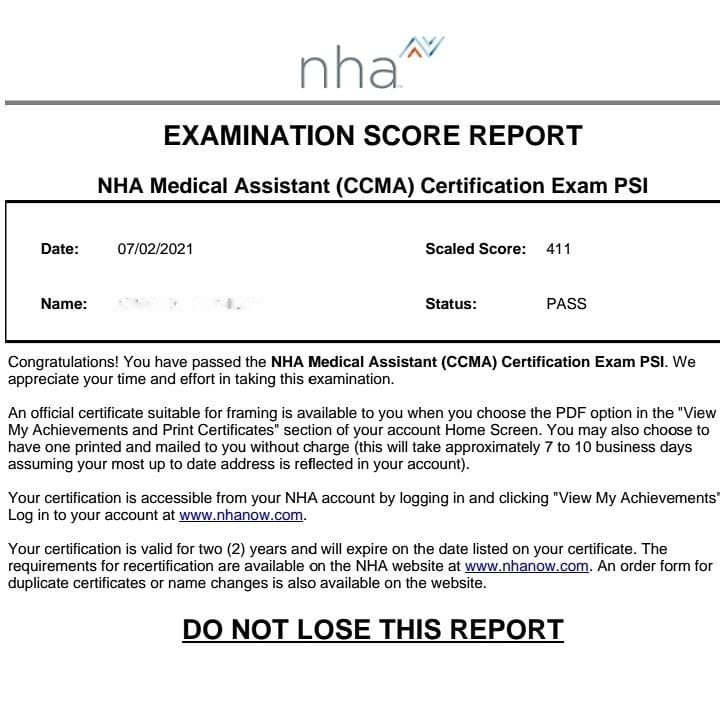
The National Healthcareer Association (NHA) Certified Clinical Medical Assistant (CCMA) exam results are a scaled score rather than a specific numerical score. The scaled score is a standard method that equates the difficulty level of different exam forms and ensures fairness across all test takers.
The scaled scores for the CCMA exam are in three categories: Pass, Provisional Pass, and Fail. The specific score ranges may vary slightly depending on the exam version, but here is a general breakdown:
Pass: This indicates that the candidate has demonstrated the necessary knowledge and skills to meet the minimum competency requirements for certification as a Clinical Medical Assistant. The score range for a pass may vary but generally falls within the higher end of the scaled score range.
Provisional Pass: This status indicates that the candidate has achieved a scaled score close to the passing range but requires additional steps to meet the certification requirements. Candidates who receive a provisional pass may need to complete specific tasks or provide documentation to obtain full certification.
Fail: Candidates who do not achieve the minimum scaled score necessary to meet the certification requirements will receive a failed result. These candidates did not demonstrate the knowledge and skills needed to pass the CCMA exam.
It’s important to note that the NHA determines the exact score ranges for each category. Scores may be adjusted periodically to maintain consistency and fairness in the certification process. For the most accurate and up-to-date information, refer to the NHA’s official website or contact them directly.
Administration
Test Administrators: The National Healthcareer Association (NHA) administers the CCMA. NHA is an organization that provides certifications for various healthcare professions, including the Certified Clinical Medical Assistant (CCMA) certification.
Test Format: Multiple choice on computer
Test Materials: Only a computer system is required
Cost: You must pay$160 to sign up for the CCMA test.
Retake Policy: A candidate can retake the test two times with a minimum interval of 30 days between each attempt.
Test Provider
The National Healthcareer Association (NHA) provides the Certified Clinical Medical Assistant (CCMA) certification. It is a professional certification agency that offers a variety of certifications for healthcare professionals, including medical assistants, phlebotomists, pharmacy technicians, and more. The CCMA certification is for individuals seeking to become clinical medical assistants. It validates their knowledge and skills in patient care, clinical procedures, medical office management, and communication.
Information Sources
- National Healthcareer Association (NHA)
- AES Education
Disclaimer - All tutoring resources and preparation materials available on iPrep are authentic and designed for tutoring. iPrep is not affiliated with the National Healthcareer Association (NHA), the owner of the Certified Clinical Medical Assistant (CCMA) certification test, or any trademark or organization mentioned above.
Link nội dung: https://mozart.edu.vn/nhacstudy-a8378.html