


Halogenation of Benzene via Electrophilic Aromatic Substitution
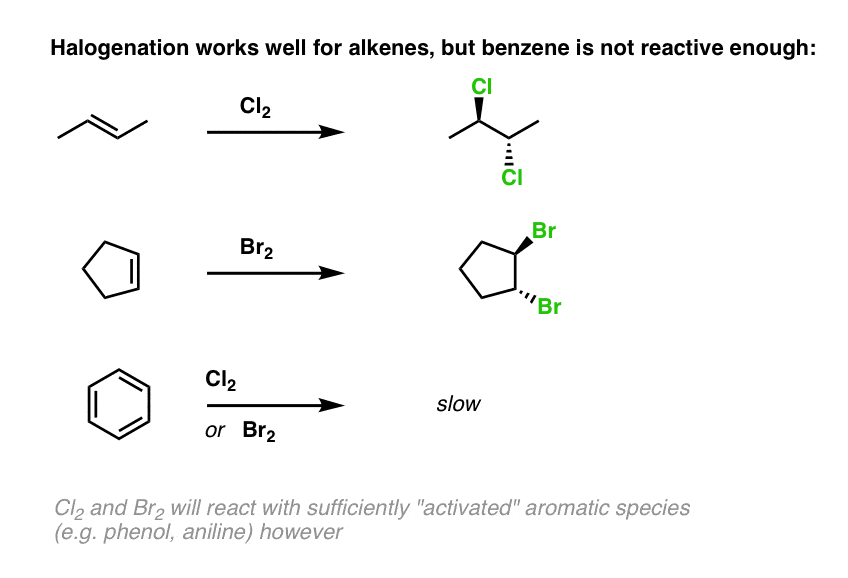
- Unlike alkenes, benzene does not undergo rapid chlorination or bromination with Cl2 or Br2
- When it does undergo reaction with halogens, it occurs via substitution instead of addition; a C-H bond on the aromatic ring breaks, and a C-X bond forms (where X is a halogen).
- This occurs via electrophilic aromatic substitution, with the rate limiting step being attack on the halogen electrophile by the aromatic ring. This generates a carbocation intermediate, which is quickly deprotonated to re-generate the aromatic ring.
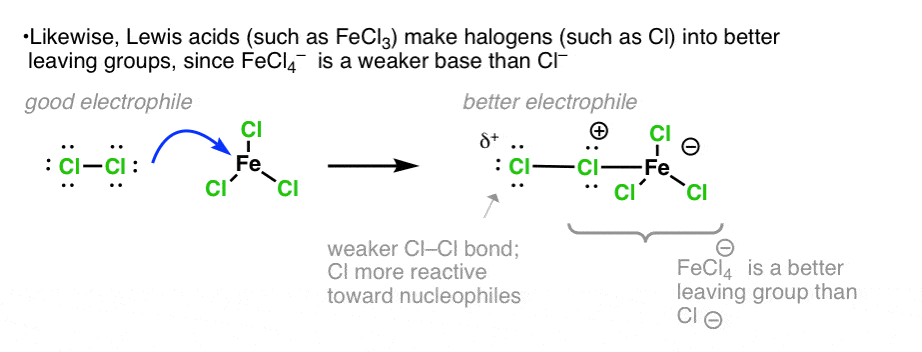
- Halogenation can be made much more rapid by using a Lewis acid such as AlCl3 or FeCl3. This accepts a lone pair from the halogen, making the halogen an even better electrophile.

[What about fluorine? If F2 wasn’t such a ravenous beast, we’d include it too, but as it stands, fluorine is best introduced to aromatic rings indirectly]
Table of Contents
- Halogenation of Benzene via Electrophilic Aromatic Substitution
- Lewis Acids Can Be Used To “Activate” Electrophiles
- Electrophilic Chlorination of Benzene
- Electrophilic Bromination of Benzene
- Electrophilic Iodination of Benzene
- Summary: Halogenation of Benzene
- Notes
- Quiz Yourself!
- (Advanced) References and Further Reading
1. Halogenation of Benzene via Electrophilic Aromatic Substitution
Now that we’ve spent ample time digging into
- the mechanism of electrophilic aromatic substitution,
- activating and deactivating groups, and
- ortho- ,para- and meta- directors,
we’re finally ready to dig into some specific reactions in detail. First up: halogenation. How do we install Cl, Br, or I on an aromatic ring?
You may recall that alkenes react readily with Cl2, Br2, and I2 to form dihalides.
Benzene? Not so much. And when it does react with aromatic rings, it provides substitution rather than addition products.
[Why? Recall that the resonance energy of benzene is about 36 kcal/mol, and electrophilic aromatic substitution disrupts aromaticity. ]
2. Lewis Acids Can Be Used To “Activate” Electrophiles
Chlorine itself will react with “activated” benzene derivatives (such as phenol and aniline) but in order for chlorination to occur with electron-neutral or electron-poor aromatics, it needs a kick in the pants.
This “kick in the pants” is provided by a Lewis acid. FeCl3 or AlCl3 are the industry standard, but in practice many different Lewis acids can be employed.
You may recall from the chapter on alcohols that protic acids are commonly used to turn poor electrophiles (e.g. alcohols) into better electrophiles by converting an alcohol into its conjugate acid. [See article: What Makes a Good Leaving Group?].
The “activated” alcohol is then able to participate in nucleophilic substitution or elimination reactions that it would not have been able to participate in otherwise:
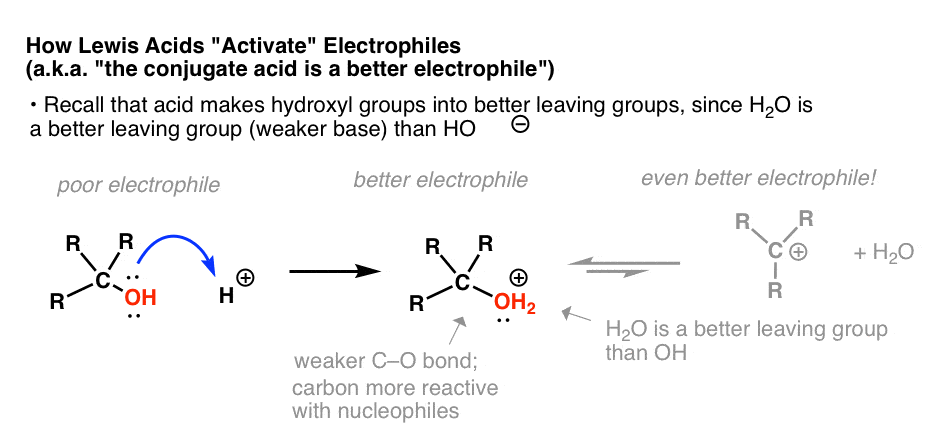
[The leaving group may even depart entirely to give a carbocation, an even better electrophile!]
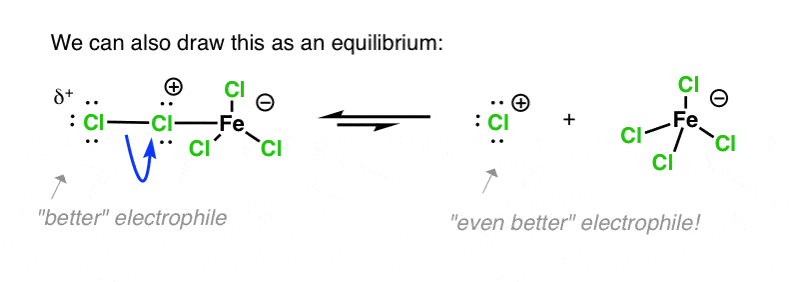
In much the same way, coordination of the Lewis acid to one of the chlorines converts it into an even better leaving group, with the net effect of weakening the Cl-Cl bond. Attack on the terminal Cl by a nucleophile results in the loss of [Cl-FeCl3]- , an even better leaving group than Cl- .
Sometimes we draw this as an equilibrium. Textbooks vary. I personally prefer showing the intact Cl-Cl bond.
3. Electrophilic Chlorination of Benzene
This “activated” electrophile can then be attacked by the nucleophile (the benzene ring) in an electrophilic aromatic substitution reaction. Here, C-Cl forms, and the C-C (pi) bond breaks!
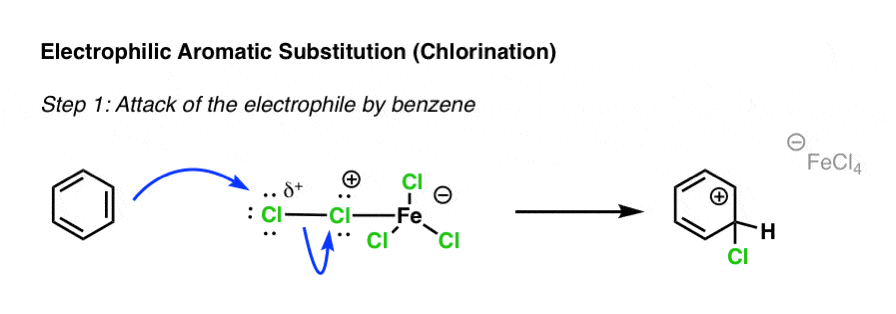
In the next step, a weak base removes a proton from the carbocation intermediate, breaking C-H and forming C-C (pi).
If this looks a tiny bit familiar, that’s because this second step greatly resembles the second step in the E1 reaction. As in the E1, only a very weak base is required to remove a proton adjacent to a carbocation. The chloride ion (Cl- ) will do.
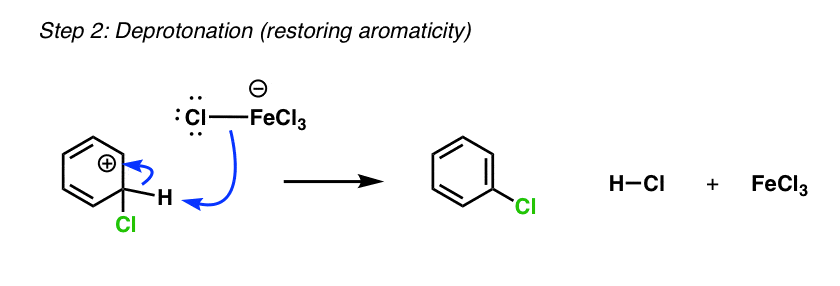
[Note: there are a lot of different ways to draw this, I’ve only shown one. See Note 1].
The final product here is chlorobenzene plus one equivalent of HCl. The FeCl3 is then free to react with another equivalent of Cl2 . In other words, it behaves as a catalyst in this reaction.
4. Electrophilic Bromination of Benzene
The same set of principles operate for electrophilic bromination. Here, the Lewis acids used are often FeBr3 or AlBr3. [Why not FeCl3 or AlCl3? Note 2]
The first step is activation of Br2, followed by attack and deprotonation, as before:
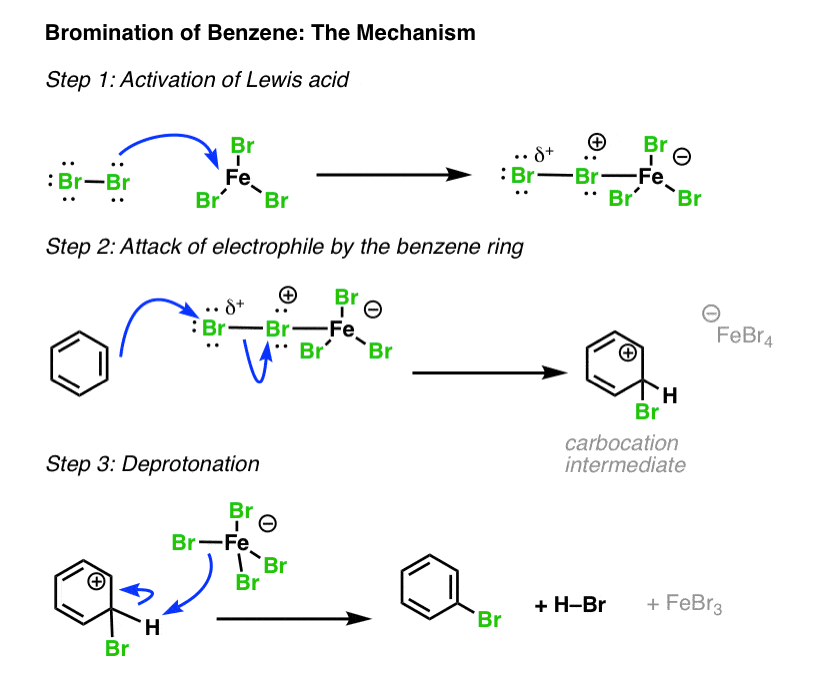
It’s essentially the same reaction as chlorination except with the halogens swapped out.
5. Electrophilic Iodination of Benzene
It’s also possible to iodinate benzene using I2 , but the activation step is different. Here, however, it turns out that a Lewis acid catalyst is not sufficient to make iodine an active enough electrophile to react with most aromatic rings.
Instead, a stoichiometric amount of an oxidant is used to convert I2 to I+ . A common example cited is HNO3, which in the presence of additional acid (e.g. H2SO4) is a source of the very active oxidant [NO2]+ which converts I2 to I+ . [Note 3]
Once formed, the benzene ring then reacts with I+ in the two-step electrophilic aromatic substitution mechanism to give the new carbon-iodine bond.
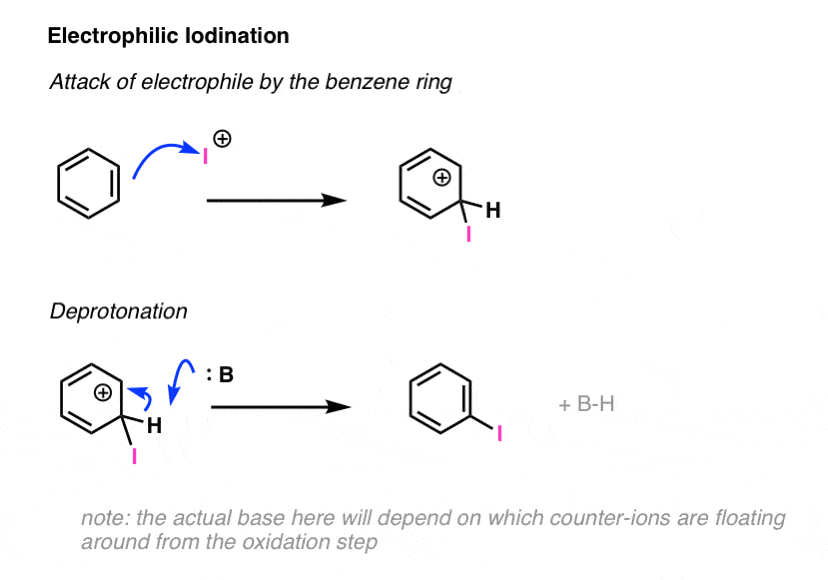
The exact identity of “B” will depend on the oxidant used to convert I2 into I+ . A single equivalent of water will do the trick, for example.
6. Summary: Halogenation of Benzene
In the cases of chlorine, bromine, and iodine, electrophilic aromatic substitution follows three steps.
- Activation of the electrophile by a Lewis acid catalyst (or stoichiometric oxidant, in the case of iodine)
- Attack of the activated electrophile by the aromatic ring.
- Deprotonation to regenerate the aromatic ring.
In the next post we’ll cover two more important electrophilic aromatic substitution reactions: sulfonation and nitration, and they will also follow this three-step pattern!
Notes
Note 1. There are a few different ways one could depict this; the drawing above shows the pair of electrons in the Fe-Cl bond acting as the base, which is essentially the same as dissociation of Cl- from FeCl4(-) followed by it acting as a base. One could also draw a lone pair from the Cl of FeCl4 acting as a base, giving H-Cl-FeCl3, followed by breakage of the Fe-Cl bond to give FeCl3 and HCl.
Note 2. It’s not that FeCl3 or AlCl3 aren’t strong enough to do the job here; the problem is that using Br2 in the presence of FeCl3 will lead to some scrambling of the halogens, resulting in a small amount of chlorination products. Using the bromide salts eliminates this problem.
Note 3. Many other oxidants have found use in this reaction. Another is copper (II) bromide (CuBr2).
Quiz Yourself!
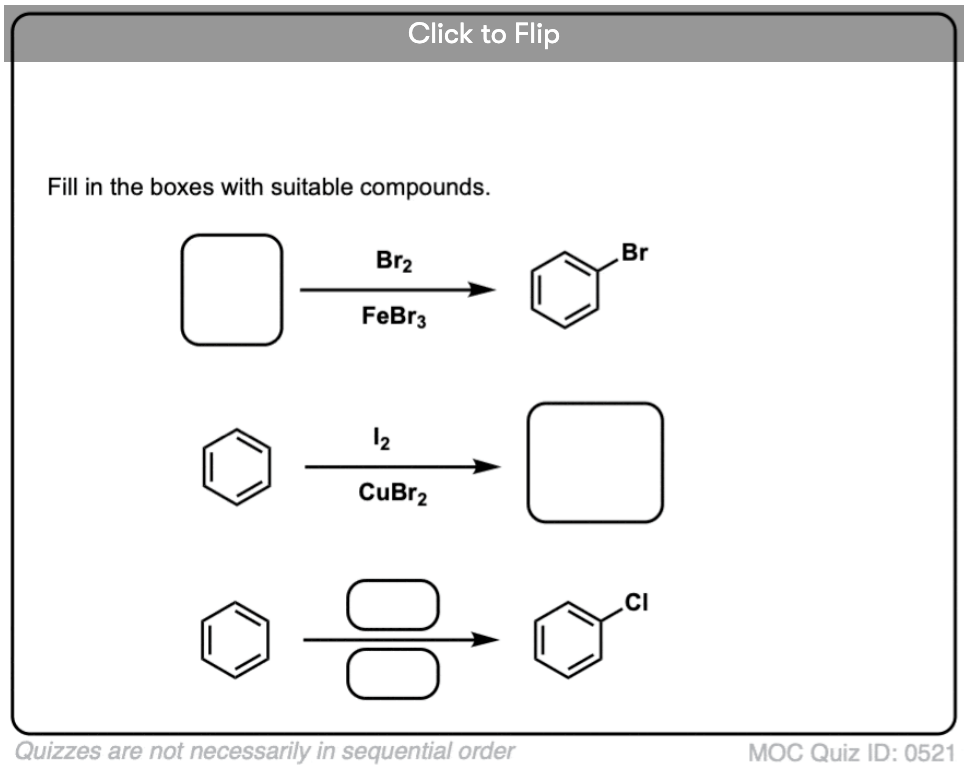
Become a MOC member to see the clickable quiz with answers on the back.
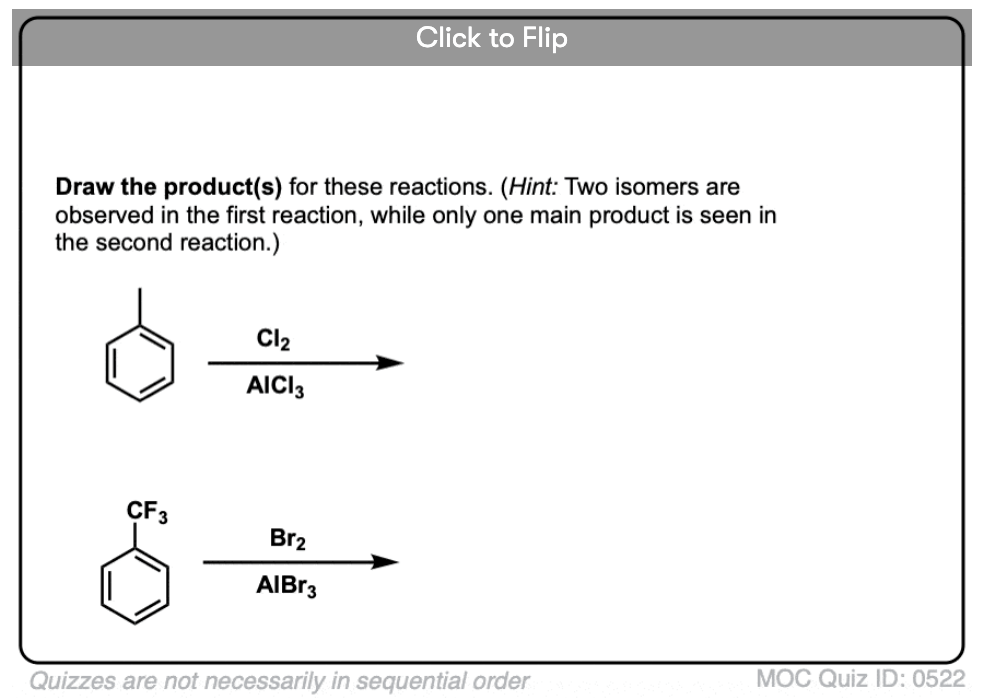
Become a MOC member to see the clickable quiz with answers on the back.
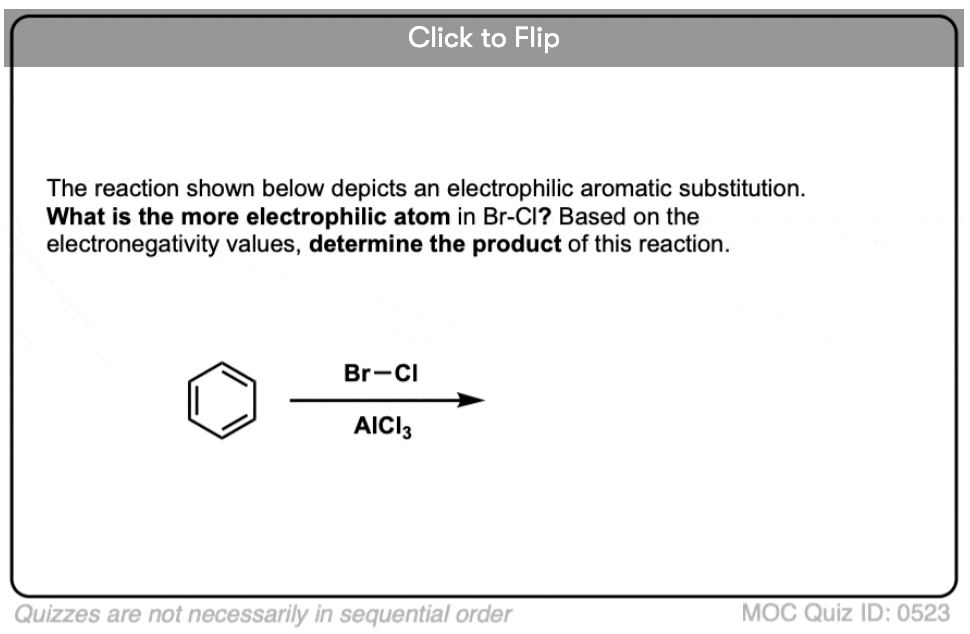
Become a MOC member to see the clickable quiz with answers on the back.
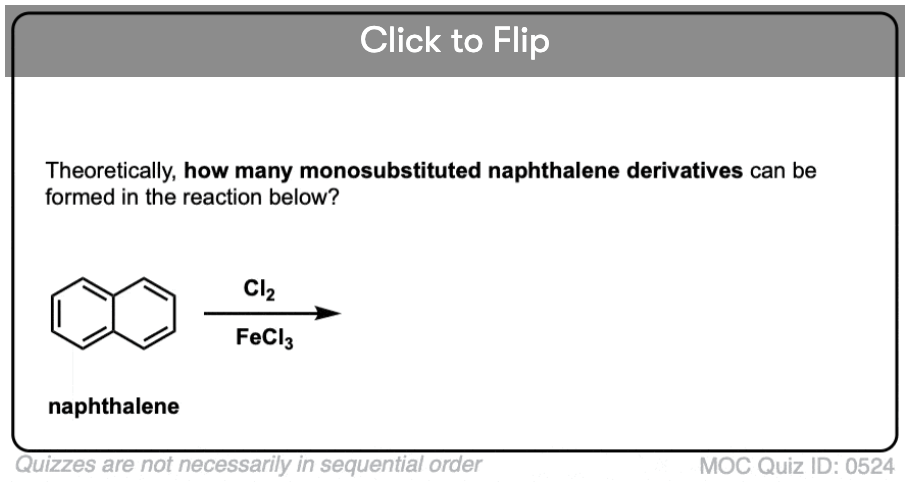
Become a MOC member to see the clickable quiz with answers on the back.
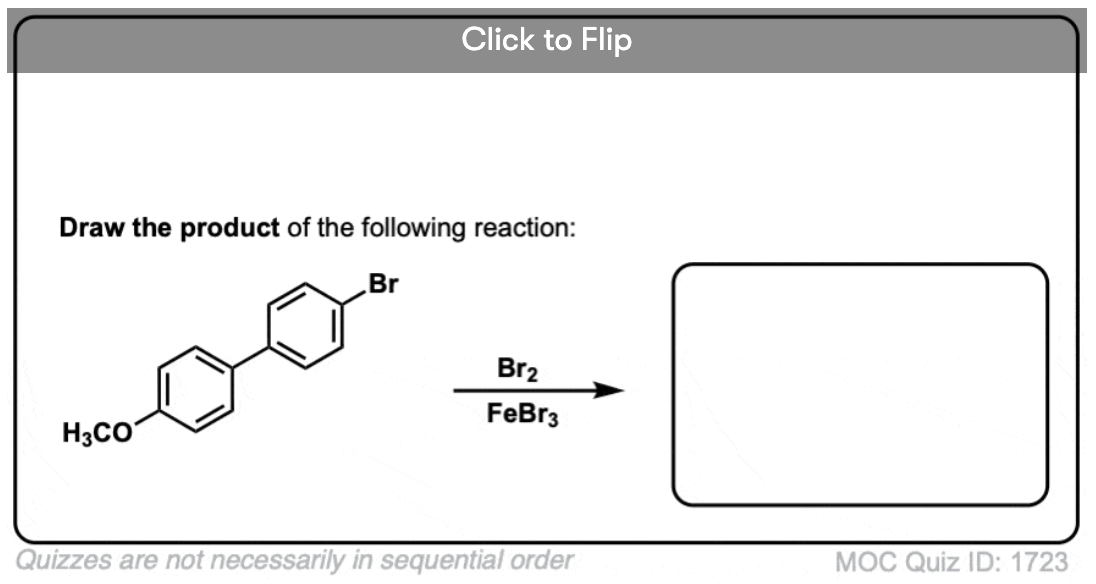
Become a MOC member to see the clickable quiz with answers on the back.
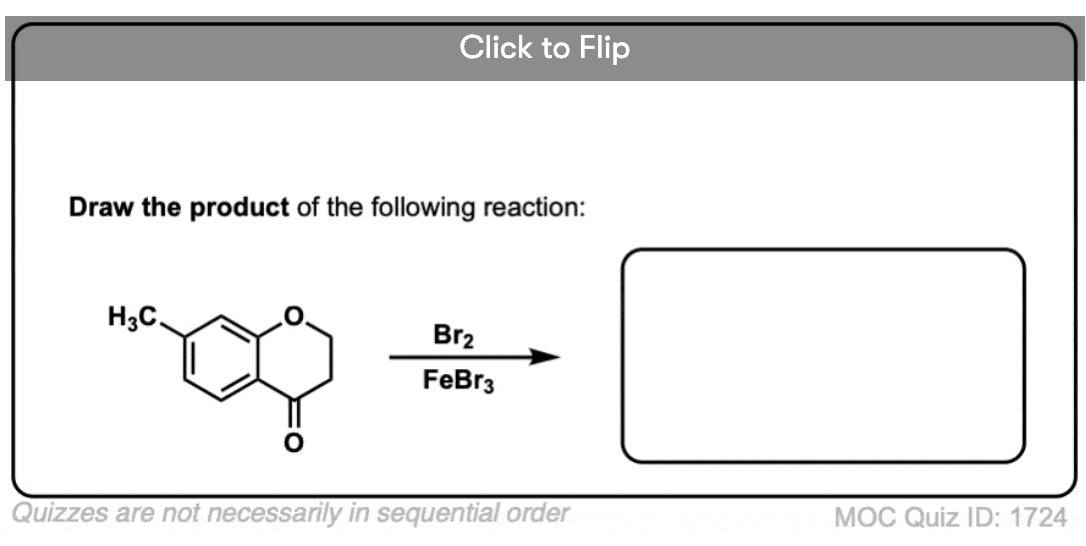
Become a MOC member to see the clickable quiz with answers on the back.
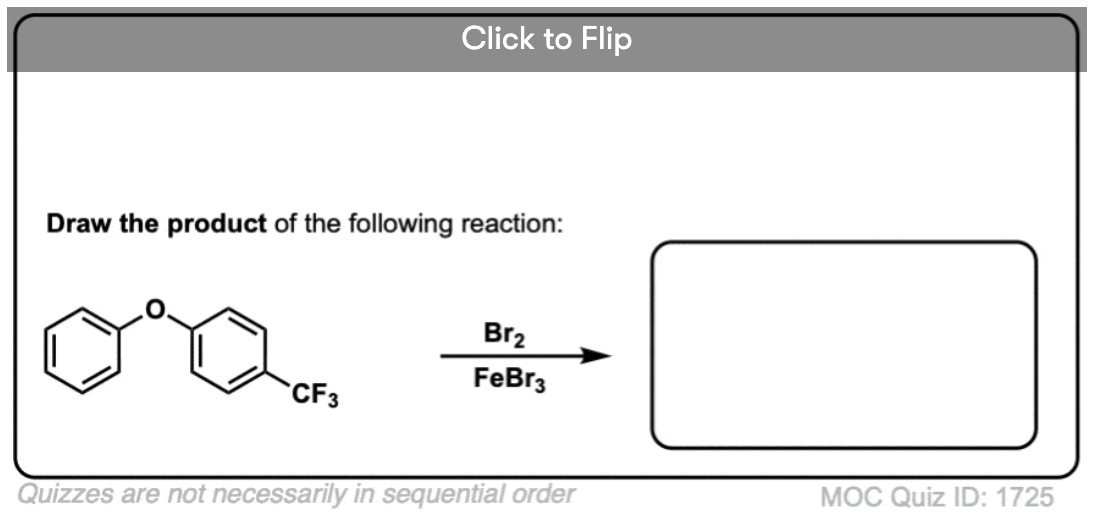
Become a MOC member to see the clickable quiz with answers on the back.
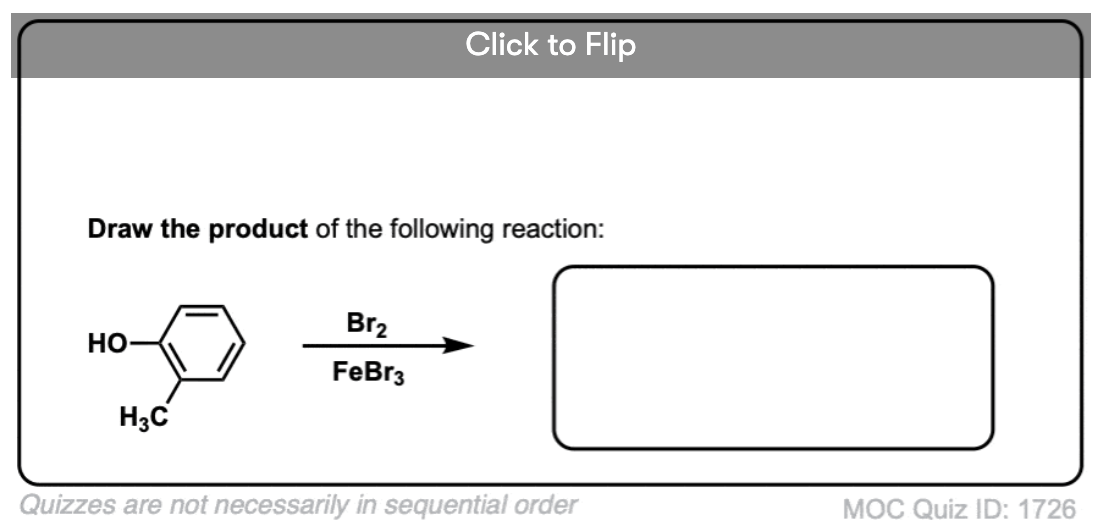
Become a MOC member to see the clickable quiz with answers on the back.
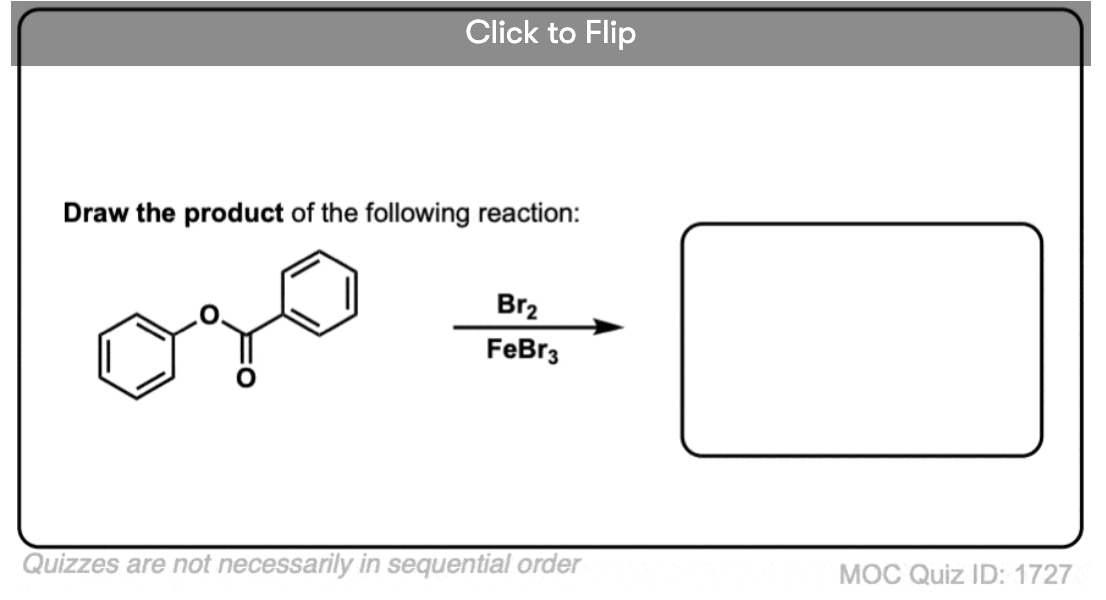
Become a MOC member to see the clickable quiz with answers on the back.
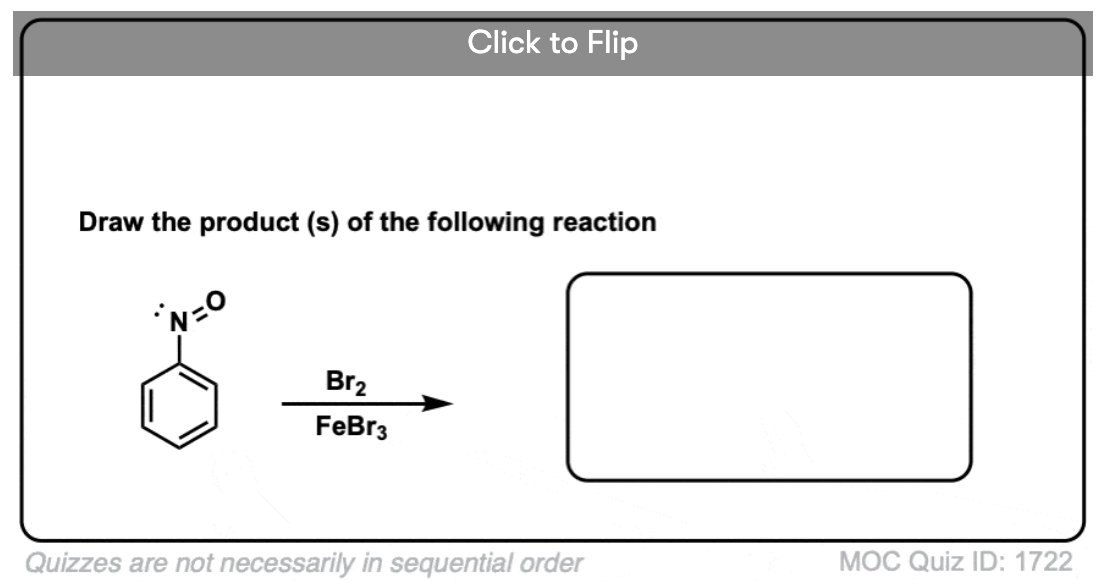
Become a MOC member to see the clickable quiz with answers on the back.
(Advanced) References and Further Reading
For more detailed references on the individual halogenation reactions (chlorination, bromination, iodination), consult the sections in the reaction guide. The references here are highlights. Electrophilic aromatic fluorination is possible, and the last two papers describe that.
Electrophilic aromatic chlorination:
- The kinetics of aromatic halogen substitution. Part IV. The 1-halogenonaphthalenes and related compounds P. B. D. de la Mare and P. W. RobertsonJ. Chem. Soc., 1948, 100-106 DOI: 10.1039/JR9480000100 An early paper studying the kinetic of electrophilic aromatic halogenation.
- Aromatic Substitution. XVII. Ferric Chloride and Aluminum Chloride Catalyzed Chlorination of Benzene, Alkylbenzenes, and Halobenzenes George A. Olah, Stephen J. Kuhn, and Barbara A. Hardie Journal of the American Chemical Society 1964, 86 (6), 1055-1060 DOI: 10.1021/ja01060a017
- Rates of Chlorination of Benzene, Toluene and the Xylenes. Partial Rate Factors for the Chlorination Reaction Herbert C. Brown and Leon M. StockJournal of the American Chemical Society 1957, 79 (19), 5175-5179 DOI: 1021/ja01576a025Electrophilic aromatic Bromination:
- Relative Rates of Bromination of Benzene and the Methylbenzenes. Partial Rate Factors for the Bromination Reaction Herbert C. Brown and Leon M. Stock Journal of the American Chemical Society 1957, 79 (6), 1421-1425 DOI: 1021/ja01563a040
- Aromatic Substitution. XIV. Ferric Chloride Catalyzed Bromination of Benzene and Alkylbenzenes with Bromine in Nitromethane Solution George A. Olah, Stephen J. Kuhn, Sylvia H. Flood and Barbara A. Hardie Journal of the American Chemical Society 1964, 86 (6), 1039-1044 DOI: 10.1021/ja01060a014
- Aromatic Substitution. XV. Ferric Chloride Catalyzed Bromination of Halobenzenes in Nitromethane Solution George A. Olah, Stephen J. Kuhn, Sylvia H. Flood, and Barbara A. HardieJournal of the American Chemical Society 1964, 86 (6), 1044-1046 DOI: 1021/ja01060a015Electrophilic aromatic iodination:
- Halogenation with copper(II) halides. Synthesis of aryl iodides William C. Baird and John H. Surridge The Journal of Organic Chemistry 1970, 35 (10), 3436-3442 DOI: 10.1021/jo00835a055 A simple and straightforward method for synthesizing monoiodoarenes using CuI2 as the iodinating agent.
- Electrophilic Fluorination of Aromatics with Selectfluor™ and Trifluoromethanesulfonic Acid Tatyana Shamma, Herwig Buchholz, G.K. Surya Prakash, and George A. OlahIsrael J. Chem. 1999, 39 (2), 207-210 DOI: 1002/ijch.199900026 This paper describes the use of Selectfluor™ as a reagent for electrophilic aromatic fluorination. Selectfluor is a commercially available, easily-handled solid, and a convenient source of “F+” due to the N-F bond.
- Palladium-catalysed electrophilic aromatic C-H fluorination Kumiko Yamamoto, Jiakun Li, Jeffrey A. O. Garber, Julian D. Rolfes, Gregory B. Boursalian, Jannik C. Borghs, Christophe Genicot, Jérôme Jacq, Maurice van Gastel, Frank Neese & Tobias RitterNature 2018, 554, 511-514 DOI: 10.1038/nature25749This paper is more advanced and covers a current topic in organometallic chemistry - the use of Pd(IV) fluorides for fluorination. For those following the literature, Prof. Melanie Sanford (U. Michigan) and Prof. Tobias Ritter (this paper, Harvard, now at Max Planck Institute (Germany)) have been going back and forth on this topic.